

"I need the extra help"
or, My Love Affair with Journaling


How and What I Journal
"According to surveys, about half of us have written in a journal at some point in our lives, and somewhere in the neighborhood of 1 in 6 people are active journalers right now."—The Power of Journaling1
As a journaling teenager, I had unwittingly followed a writing path similar to Julia Cameron's "morning pages2."
I'd start by recapping the day's highlights on paper. If I persisted, eventually an indescribable, mycelial effect would take over, and I'd write for pages and pages. That stream-of-consciousness writing process often ended in creativity—sketches, poetry, lyrics, story ideas, etc.
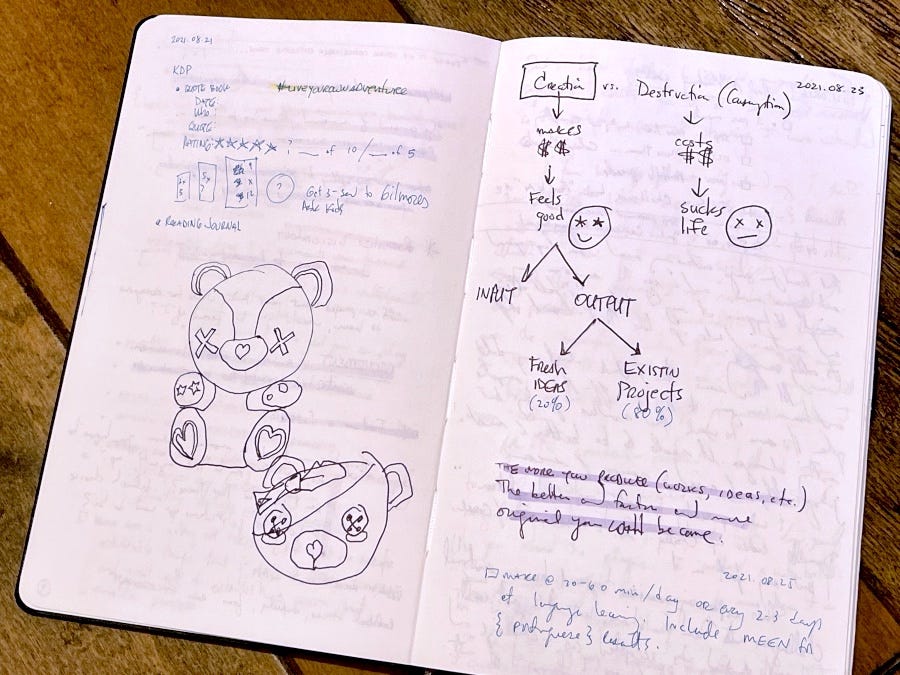
Besides creative results, journaling has had a homeostatic effect on me. It helped recalibrate my thoughts and feelings in order to more fully experience contentment and happiness. In some ways, I was gratitude journaling. But I've also used journaling to process negative feelings and trauma, moving toward an internal reconciliation without requiring the participation of related parties.
“The Power of Journaling” article at PsychologyToday.com adds that 'what and how we write seems to matter.' And I really believe that.
Two Positive Effects
Journaling has had two opposite effects:
It disempowered overwhelming thoughts. I could take horrible thoughts written on paper, crumple them, rip them, or burn them, thus, symbolically—and literally—discharging them. Somehow, that physical manifestation over the thought had transmutative qualities.
It made the humblest idea seem viable, even if just an entertaining fiction, but seeing an idea made real on paper created the possibility that the idea could be realized in bigger ways.
While reviewing past journals, I've found that most pages are ordinary, day-in-the-life moments. Apart from some dark days, I've been in love with humanity most of my life. And from time to time, there's a gem—a lost memory found, a page worth keeping.
Best of all, journaling has provided a chronicle of personal growth and served to help identify areas of life that needed work. It's an ongoing process.
I often imagine I've benefited from journaling in a similar way I might have benefitted from seeing a therapist. And there's no stopping me now. I need every bit of extra help I can get. How about you?
R. Maurice Ledesma
Studio Gootank
Next Issue…
Using the Fractal Planner’s 12-Month View
Available from Studio Gootank
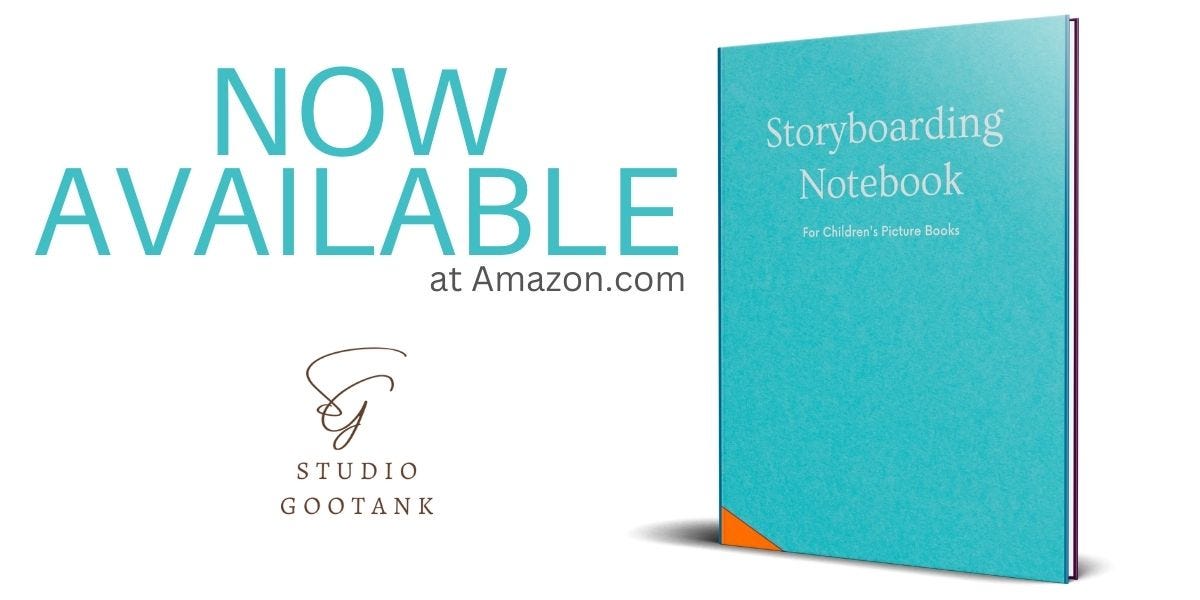
The Storyboarding Notebook for Children's Picture Books serves a dedicated purpose: capturing and working on picture book ideas. It's easily identifiable—it's large, brightly colored hardcover notebook. So, no more hunting for that lost picture book idea stored somewhere in one of my many completed or in-progress notebooks, journals, or planners.
TIP: Given the paper available via Amazon's KDP, I've found that pencils and 0.3 HI-TEC-C pens avoid bleed-through. It's currently available only at Amazon.